
Resistance Welding for making 32AWG high-speed backplane cables
- TOP
- Resistance Welding
- Applications of Resistance Welding
- Resistance Welding for making 32AWG high-speed backplane cables
As generative AI becomes more widespread, the transmission speeds of equipment for AI data centers are increasing.
Traditional printed circuit board type backplanes cannot transmit data at speeds above 25 Gbps.
High-speed backplane cables have been developed to address this issue, and products supporting transmission speeds of up to 112 Gbps are now available.

High-speed backplane cable challenge
As the communication speed of backplane cables increases, the frequency bands used also increases.
Higher frequencies cause increased resistance loss due to the skin effect, making it very difficult to synchronize multiple signals.
(Reference)
Skin effect: A phenomenon in which high frequency current flows concentrated near the surface of a conductor, increasing effective resistance and resulting in greater signal loss.Therefore, it is important to maintain a good termination from the cable to the connector while maintaining the appropriate characteristic impedance (typically 85-100 ohms).
How to join a 32AWG cable to a rigid board
Equipment for AI data centers and high-performance computing systems must pack many components into a limited space.
Thinner cables such as 32AWG can be wired in a much smaller volume than conventional thicker cables, which helps to miniaturize equipment and enable higher-density packaging.
High-speed backplane cables are supplied with connectors on both ends of the cable.
Each of these cables are then joined to the connector terminals on the connector's rigid circuit board.
Soldering is the most common method for connecting connector terminals to cables.
When soldering, if foreign matters such as brazing material gets into the signal line, communication degradation occurs due to reflection, so care must be taken to ensure that the solder height and solder volume are consistent.
Direct joining using resistance welding is becoming more common because signals are more stable when there are no foreign materials such as brazing metal.
Advantages and disadvantages of Resistance Welding
Here are three advantages and one disadvantage of resistance welding.
Advantage 1: Solderless bonding
Resistance welding is a direct joining method to terminals or patterns on a circuit board without using solder.
By not using solder, factors that cause communication degradation such as impedance fluctuation and signal reflection can be suppressed. In addition, eliminating the need for solder material reduces costs.
Advantage 2: High quality and high reliability
Direct resistance welding ensures stable joint quality for each terminal.
When soldering, controlling the amount of solder for each terminal is strict and causes variations.
Resistance welding does not use solder, so the effects of variability can be avoided.
Advantage 3: Suppression of thermal effects
Resistance welding reduces the thermal load compared to conventional soldering and suppresses the thermal impact on surrounding components and devices.
Disadvantage of Resistance Welding
Resistance welding requires each terminal and cable to be welded separately.
If multiple terminals are welded at once, the current may be split among the terminals, resulting in uneven joint quality.
For Resistance Welding of backplane cables, Avio’s NRW-IN400PA is recommended
32AWG is very thin, so excessive current can cause spatter or melting the wire.
By using an inverter welding power supply, precise current control is possible while minimizing the thermal effects.
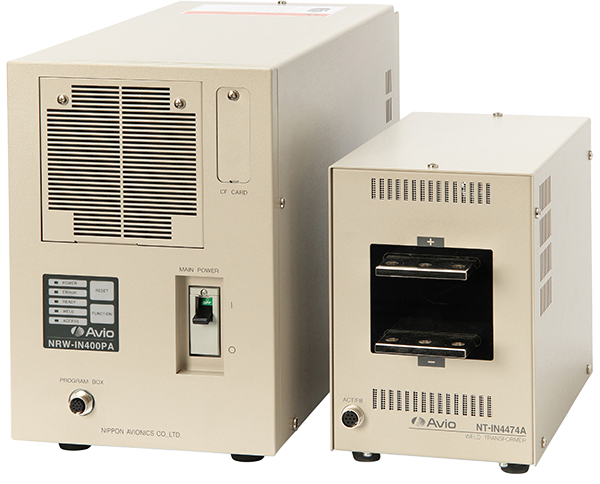
Nippon Avionics' resistance welding machine “NRW-IN400PA” suppresses spatter with Feedback Shift function and achieves stable joint quality with current control for each shot.
What is Feedback Shift?
Feedback control is a control method that detects fluctuations in the three major conditions of welding current, welding time, and electrode pressure in real time and automatically corrects them.
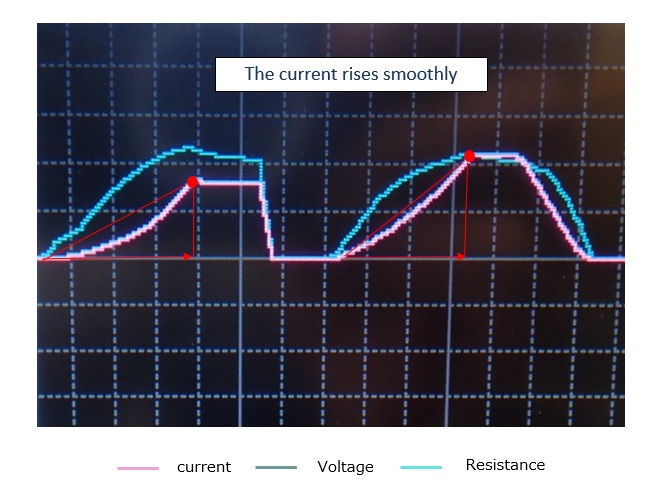
Feedback Shift is a function that monitors feedback values other than the control mode (current, voltage, etc.) and shifts to the next phase when the set limit value is reached.
Avio's resistance welding machine “NRW-IN400PA” can set the current waveform arbitrarily, and when combined with the Feedback Shift function, it is possible to apply current that is appropriate for the workpiece.
Furthermore, the ability to control the current for each shot helps stabilize the joining quality and suppresses factors that cause communication degradation, such as impedance fluctuations and signal reflections.
For detailed specifications, please see the product page.

| Joining Method | Resistance Welding |
|---|---|
| Processing Method | Metal Joining |
| End Products | backplane cable |
Sample testing
We will be pleased to test your sample with our proposed joining method, and return it with a report.